NTA Green Energy: a rooftop solar website built to produce enquiries
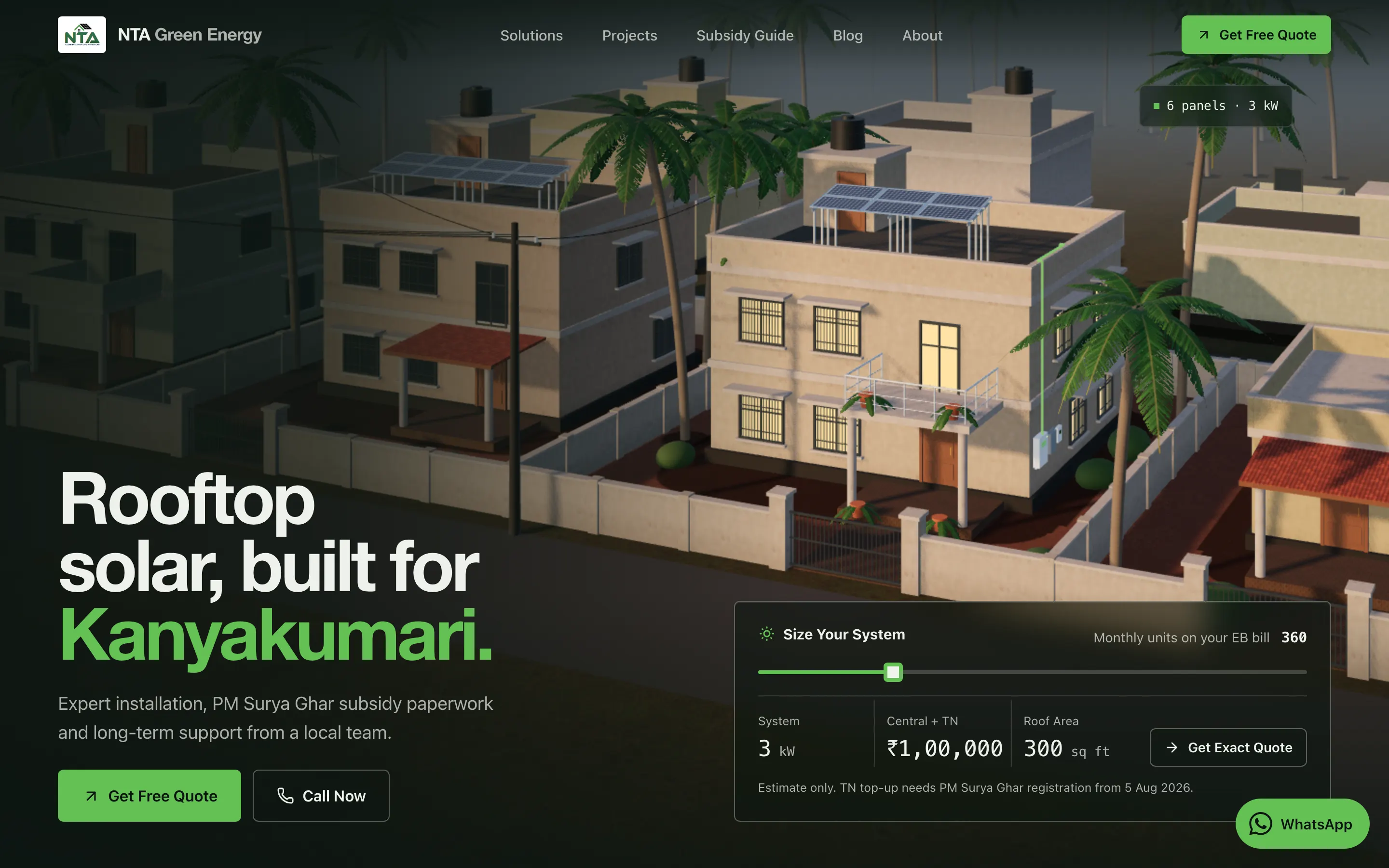
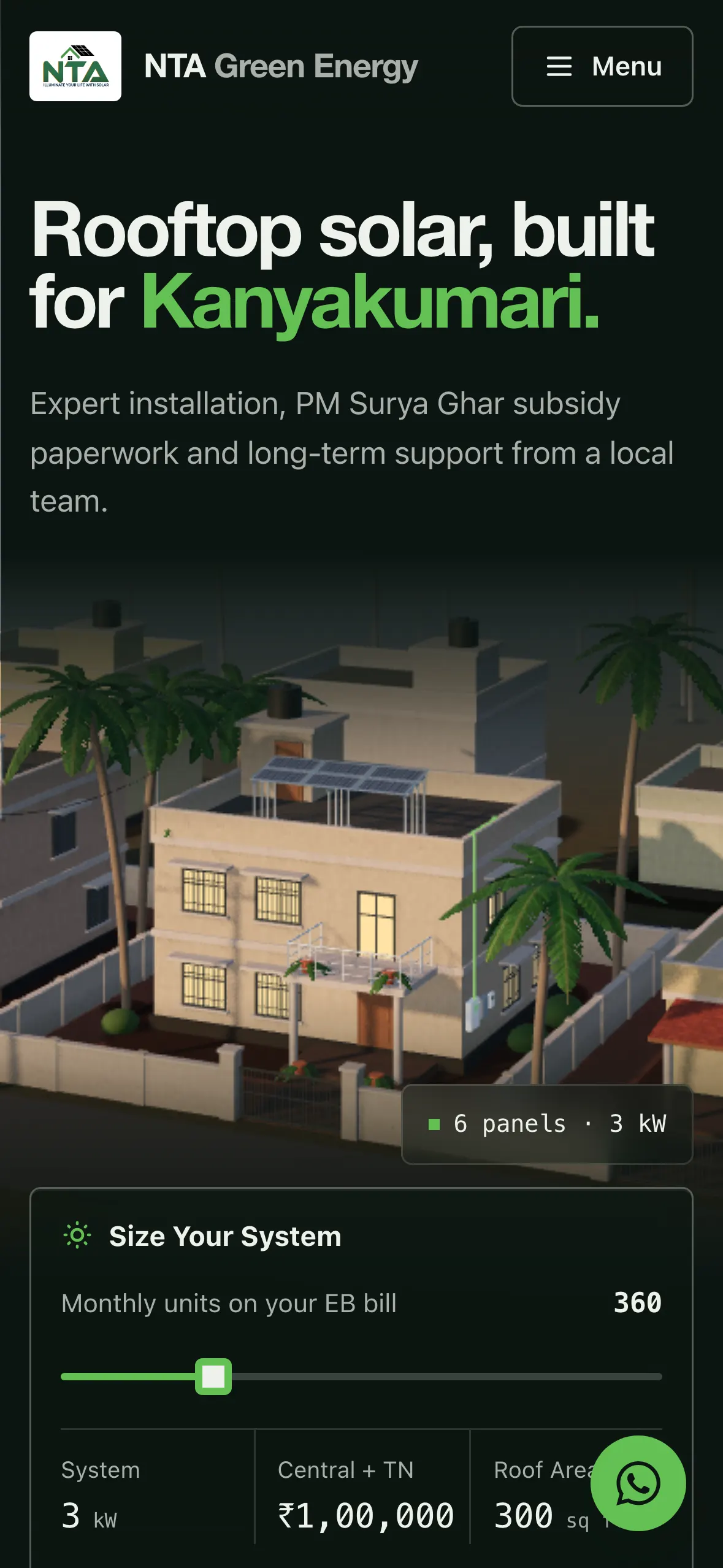
A rooftop solar website with a live system sizer and subsidy guide that answers cost questions before sales gets involved.
LiveRooftop solar website, content management and admin panel
Our role
What BitsSolved did
- Website design and build
- Subsidy guide and system sizer on the home page
- Enquiry capture on the pages that earn it
- Blog with content management
- Admin panel
- SEO built into the templates
What NTA Green Energy did
- Publishes its own blog and pages
- Updates subsidy content in the admin panel
- Runs enquiries from the admin panel
- Owns the website and its content
Why most solar company websites do not generate enquiries
Rooftop solar is not an impulse purchase. A homeowner weighing a three kilowatt system against a monthly electricity bill wants three answers before they will hand anyone a phone number: what the system costs, what subsidy they qualify for, and how long it takes to pay for itself. Almost all of that research happens on a phone, in the evening, long before a salesperson is anywhere near the conversation.
Most solar company websites answer none of it. They open on a stock photograph of panels against a blue sky, list residential, commercial and industrial as though the visitor did not already know which one they are, and finish with a contact form. The visitor leaves to find the numbers somewhere else, and the enquiry goes to whoever published them.
NTA Green Energy needed the opposite site: one that does the explaining, and then captures the people it has convinced on the page where the convincing actually happened. It also had to be a site the company could keep changing on its own, because subsidy rules move, and a business that has to call a developer to correct a number stops correcting it.
- Sector
- Rooftop solar installation
- Region
- Tamil Nadu, India
- Rating
- 5.0 out of 5 from 3 Google reviews
- Scope
- Website, blog, CMS and admin panel
- Built for
- Search traffic and enquiry capture
What we built
Subsidy guidance and a system sizer on the page
The central and Tamil Nadu subsidy position explained where the customer is already asking the question, with a sizer on the home page that turns a monthly unit count into a system size and a cost against a 3D rooftop. Publishing it is what makes the enquiry a warm one.
Enquiry capture at the point of interest
Quote requests and site visit requests are raised from the page that earned them, instead of being funnelled to a single contact form three clicks away that most readers never reach.
A blog with content management
The team writes, edits and publishes its own pages. That is the entire difference between a site that earns search traffic for a year and one that earns it for five.
An admin panel for the business
Enquiries, content and the day to day work of the company run from one place, so the website is part of the operation rather than a brochure beside it.
Built for phones first
The research happens on a phone, so the layout, the forms and the page weight were designed for that case and then allowed to expand, not the other way around.
A page for each decision
Solar solutions, the subsidy guide, completed projects, about and contact each get their own page, because a homeowner working through this makes those decisions one at a time and searches for them one at a time.
The decisions that shaped it
- 01
Answer the money question on the page
The instinct in a high consideration sale is to hold the numbers back so the customer has to call. It works against you. A visitor who cannot find costs and subsidy on your site finds them on a competitor’s, and the call you were protecting never happens. Publishing the position does two things instead: it wins the visitor who was going to leave, and it means the enquiries that do arrive come from people who already accept the shape of the price.
- 02
Content management, because the rules move
Solar subsidy schemes change, and so do panel prices and warranty terms. A static site is cheaper to build and becomes wrong within months, at which point it is actively damaging: a published subsidy figure that is out of date costs more trust than no figure at all. The CMS exists so the team can correct a number the week it changes, without a ticket and without an invoice.
- 03
One enquiry, several front doors
A single contact page assumes the reader will carry their intent across three clicks. Most will not. A quote request sits on the page that explains costs, a site visit request sits on the page that explains installation, and both land in the same admin panel, so the operational simplicity of one inbox does not have to be paid for with lost enquiries.
What customers say
Based on 3 Google reviews
In the client's words.

We had a clear idea of how we wanted our business to be presented online, and BitsSolved did a great job bringing it together. The website looks clean, professional, and exactly how we imagined. The team was quick to respond, easy to coordinate with, and delivered without unnecessary complications. Overall, a really good experience.
How it is built
- Frontend
- ReactVite
- Content
- Admin CMSBlog
- Operations
- Enquiry managementAdmin panel
How the engagement ran
- 01
Discovery
A working session on your product and its architecture, written up as scope, screens and a fixed quote for the first phase. Nothing is chargeable before that document exists.
- 02
Build in the open
Working software you can open while it is being built, instead of a status report, so the brief can change while changing it is still cheap.
- 03
Launch
Deployment with monitoring, backups, TLS and security headers, on infrastructure the client owns.
- 04
Scale
A maintenance window for fixes, monitoring and improvements, or a full handover to your own engineers with documentation. You can stop after any phase and keep everything built so far.
If you install rooftop solar
The website has exactly one job in this business: get a qualified homeowner or facility manager to raise their hand before a competitor gets the same search. Everything else on it is in service of that, or it is decoration.
Publish the numbers
Cost ranges, subsidy position and payback. The enquiry you lose by publishing them is one you were never going to close; the one you win already believes the price.
Capture where interest peaks
A form on the page that answered the question converts several times better than the same form on a contact page.
Own the content
Subsidy schemes change every year. If updating the site needs a developer, the site will be wrong within two quarters.
The services behind it:Web Application DevelopmentSEO and Digital MarketingWebsite Fixes and Maintenance
Questions people ask before starting one of these
More case studies
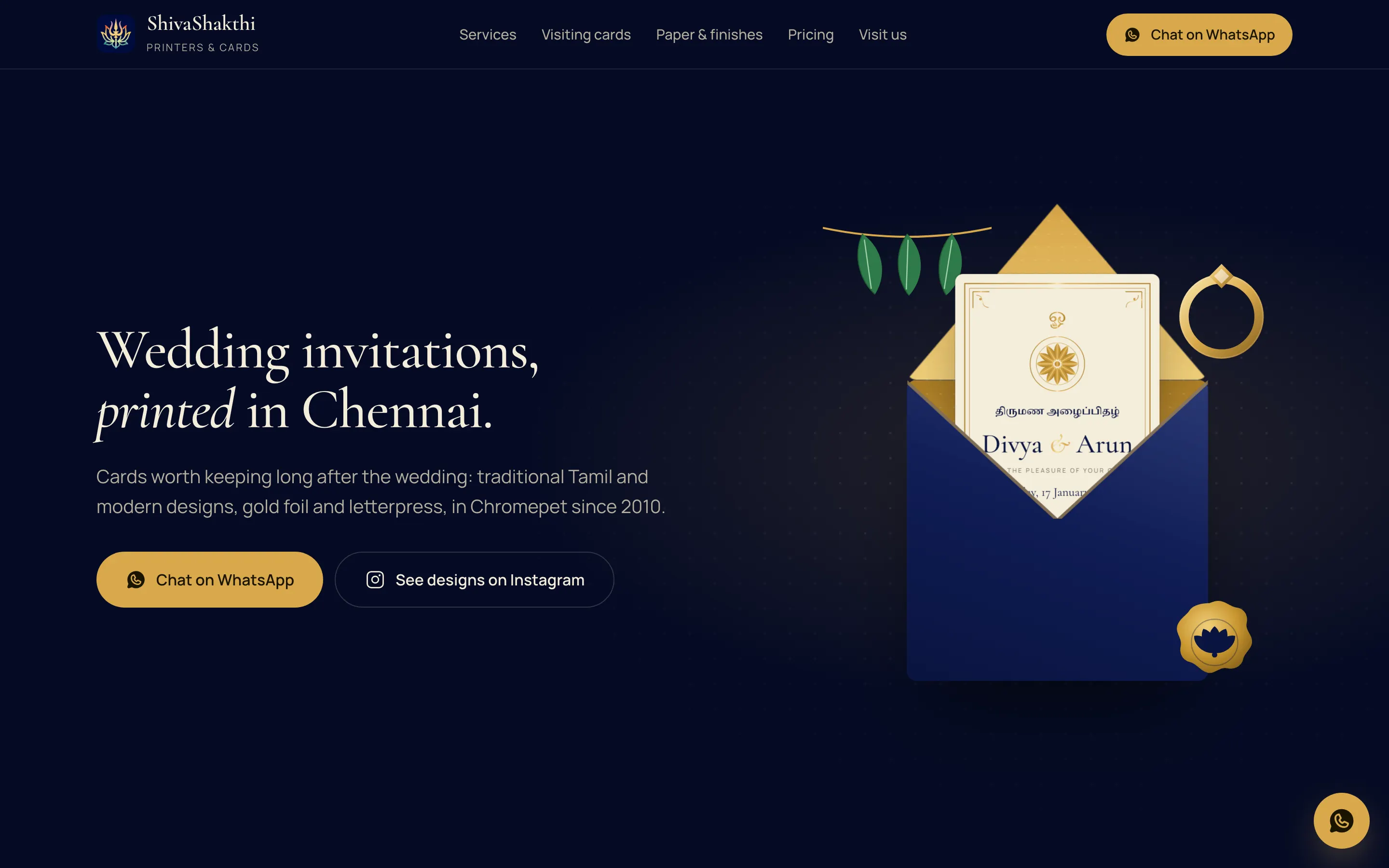
ShivaShakthi Printers
Local business website built to be found in its own city
Want something like this built?
The first call is free and is mostly us asking questions. After it you get the scope in writing and a fixed quote for the first phase.
What happens next
- You send the formTell us the problem.
- We reply by emailWith any questions.
- A free first callThen the scope in writing.