ShivaShakthi Printers: a wedding card business built to be found online
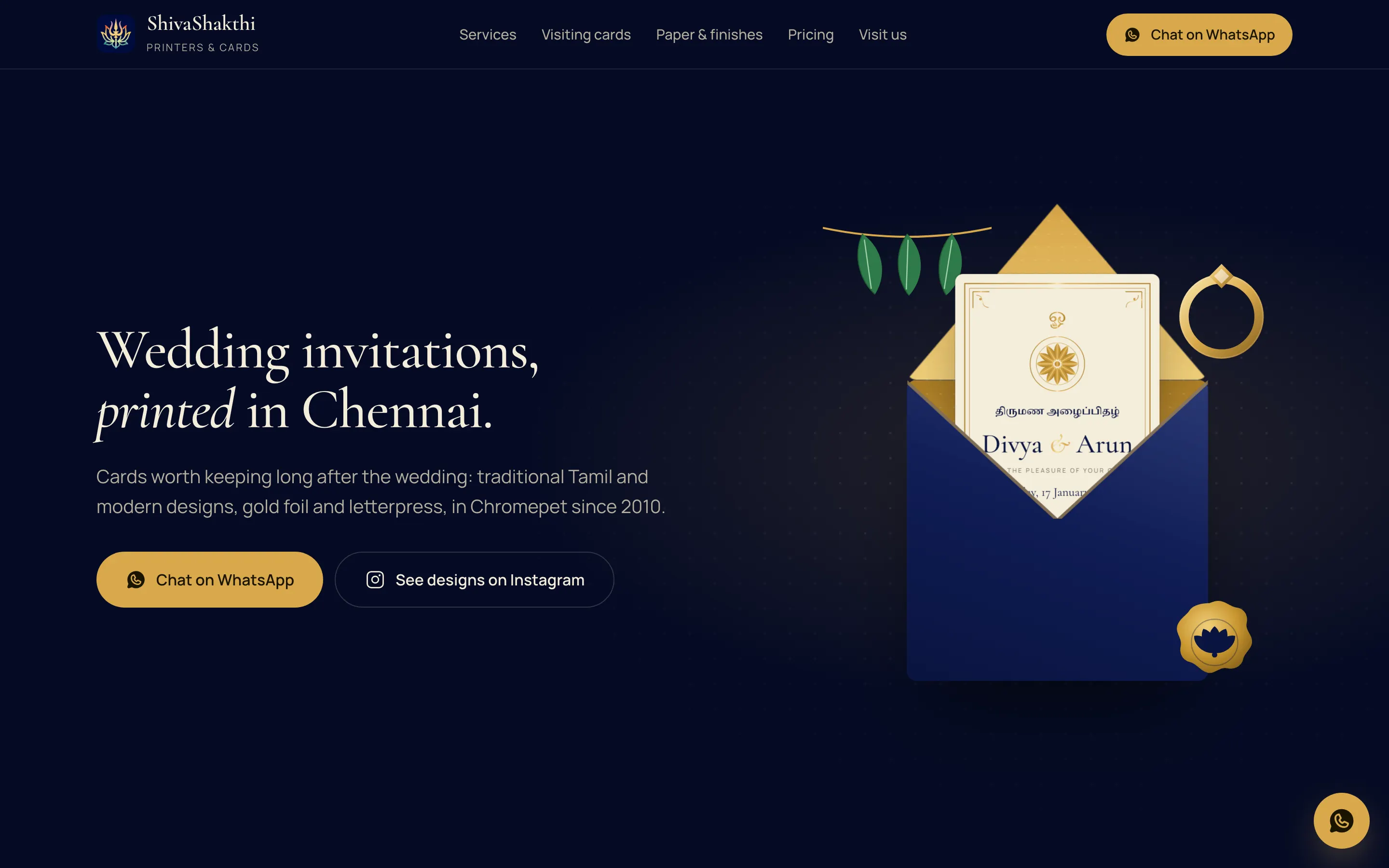
A wedding card printer's website, built around how families actually shop for invitations.
LiveLocal business website built to be found in its own city
Our role
What BitsSolved did
- Website design and build
- Local search structure and LocalBusiness markup
- Instagram marketing support: what to post and how to present the work
- Social media and ad management alongside the site
What ShivaShakthi Printers did
- The shop, its samples and its customers
- Owns the website and its code
Why a shop with a twenty year reputation can be invisible online
A wedding card is bought once, under a deadline, by a family that has never bought one before. They do not know letterpress from thermography, they do not know what a gatefold costs, and the date on the card cannot move. So they search, and they search locally: a shop they can reach, working in a language they read, that will show them a proof before anything goes on a press.
The businesses that serve those families are usually invisible to exactly that search. A printer who has been on the same road since 2010 has the reputation, the sample books and the machines, and online has a pin on a map and a listing that says printers in Chennai. The customer walking past the shutter already knows about them. The customer three suburbs away, comparing options at eleven at night, never finds them at all.
ShivaShakthi Printers needed to be findable by that second customer, and the site needed to do the reassuring a first-time buyer under a deadline actually needs before they will walk in.
- Sector
- Wedding cards and commercial printing
- Shop
- Chromepet, Chennai
- Rating
- 4.9 out of 5 from 35 Google reviews
- Serving
- Chromepet, Tambaram, Pallavaram, Chitlapakkam
- Scope
- Website, local search structure, social and ads
What we built
Pages built around the search, not the org chart
Wedding invitations, ceremony cards, visiting cards, event invitations, commercial printing and custom stationery each get their own page, because those are the things people type. A single services page mentioning all six ranks for none of them.
The process, before the price
Tell us the date and the style, see a proof before anything prints, choose the paper and finish, collect on the date we agree. A first-time buyer working to a fixed wedding date needs that sequence more than they need a rate card, and it is on the page rather than saved for the visit.
The vocabulary the customers use
Cards set in Tamil, English, Telugu and Hindi, and the actual names of the occasions being printed for: upanayanam, valaikappu, housewarming, naming ceremony, sashtiabdapoorthi. Those words are what people search with, and a site written only in English marketing language never meets them.
Paper and finish you can judge on a screen
Gold foil, embossing, letterpress and laser-cut sleeves, and the formats a card comes in, shown and explained, because the decision a customer stalls on is the one they cannot picture.
A shop that machines can read
Full LocalBusiness structured data: the street address, the map point, the opening hours and the neighbourhoods served, so search engines can place the business where it physically is rather than guess.
Instagram marketing support, and ads alongside
Help with what to post and how to present the work, run next to the website so the traffic being bought lands on pages built to receive it.
The decisions that shaped it
- 01
The page structure comes from the search, not from the business
The instinct is to mirror how the shop thinks of itself: one About page, one Services page, one Contact page. Search does not work that way. Someone printing an upanayanam invitation and someone ordering a thousand brochures are different people with different questions, and a page that serves both serves neither. Splitting by what is actually searched for is the single decision that most changes whether a local business is found.
- 02
A first-time buyer needs the sequence, not the price list
Almost every wedding card enquiry carries the same unspoken question, which is whether this will be ready and right in time. Publishing the process, and specifically that a proof is seen before anything prints, removes the fear that makes people ring three shops instead of walking into one. It is reassurance doing the work a discount would otherwise have to do.
- 03
Prerender, because a shop that cannot be crawled cannot be found
The site is built in React, but every page ships its content in the server response rather than assembling it after a bundle loads. For a business whose entire online value is being discovered in local search, content that only exists once JavaScript has run is a risk with nothing on the other side of it. The build step costs a minute; the alternative costs the traffic.
What customers say
Based on 35 Google reviews
In the client's words.

To be frank, we weren't really sure how to go about promoting our business on Instagram. The BitsSolved team helped us figure things out, from what to post to how to present our work. They also built our website, which turned out really nice. We didn't have to keep following up or explaining things again and again. That's what we liked most about working with them.
How it is built
- Frontend
- ReactViteMotion
- Rendering
- Prerendered pages
- Local search
- LocalBusiness schemaService-area markup
- Growth
- Social mediaAd management
How the engagement ran
- 01
Discovery
A working session on your product and its architecture, written up as scope, screens and a fixed quote for the first phase. Nothing is chargeable before that document exists.
- 02
Build in the open
Working software you can open while it is being built, instead of a status report, so the brief can change while changing it is still cheap.
- 03
Launch
Deployment with monitoring, backups, TLS and security headers, on infrastructure the client owns.
- 04
Scale
A maintenance window for fixes, monitoring and improvements, or a full handover to your own engineers with documentation. You can stop after any phase and keep everything built so far.
If you run a shop people search for locally
Printers, tailors, opticians, clinics, caterers, any business with a street address and customers who find it by searching from a few kilometres away. The website is not a brochure for people who already know you. It is how the ones who do not know you arrive.
Build a page per query
One page listing eight services ranks for none of them. Eight pages rank for eight things.
Put the process on the page
Whatever your customers are anxious about before they walk in, answer it before they have to ask.
Make the shop machine-readable
Address, hours and service areas as structured data, not just as text in a footer.
The services behind it:SEO and Digital MarketingWeb Application DevelopmentWebsite Fixes and Maintenance
Questions people ask before starting one of these
More case studies
Want something like this built?
The first call is free and is mostly us asking questions. After it you get the scope in writing and a fixed quote for the first phase.
What happens next
- You send the formTell us the problem.
- We reply by emailWith any questions.
- A free first callThen the scope in writing.